 Search
 Product Finder
SDI 1523 PRECISION INDUSTRIAL SURFACE MOUNT ACCELEROMETERS
Tighter thermal performance for applications that need more than conventional industrial sensing without moving to an inertial-grade accelerometer.
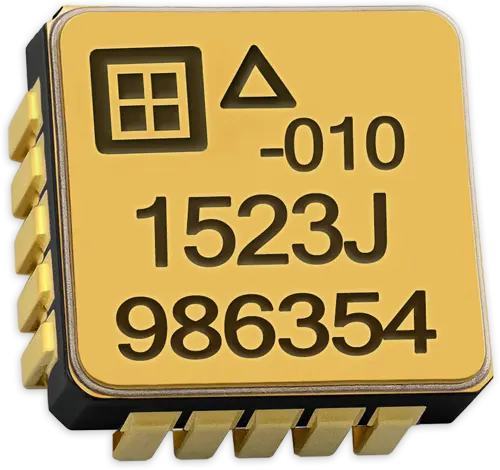
Meet the SDI 1523: Precision Industrial MEMS DC Sensing with Tighter Thermal Performance
The Model 1523 is the highest-performing accelerometer in Silicon Designs’ industrial surface-mount family. It was developed for applications where temperature-related changes in bias and scale factor represent a significant part of the measurement error budget.
Each Model 1523 undergoes individual thermal characterization and calibration during production, followed by climate-chamber verification of bias and scale-factor performance over temperature. Bias temperature coefficient is specified at ±25 ppm of span/°C, and scale-factor temperature coefficient is specified at -50/+25 ppm/°C across the -55°C to +125°C operating range.
The 1523 narrows the temperature-performance gap between conventional industrial and inertial accelerometers. For engineers who need tighter thermal performance but do not require the full performance set or cost structure of an inertial-grade device, it provides another level of performance within SDI’s industrial accelerometer family.
Key Performance Features
- Bias Temperature Coefficient: ±25 ppm of span/°C
- Scale Factor Temperature Coefficient: -50/+25 ppm/°C
- Operating Temperature: -55°C to +125°C
- Continuous Response to 0 Hz DC
- Low-Noise Differential Analog Output
- ±4 V Differential Full-Scale Output
- 5,000 g Peak Mechanical Shock Rating
- Hermetically Sealed Ceramic J-Lead Package
- Individually Thermally Characterized, Calibrated, and Verified
- Individually Serialized for Traceability
- Individual Calibration Report Included
- Standard ±10 g, ±25 g, and ±50 g Ranges
Why Choose the SDI 1523?
Tighter Thermal Performance Without Moving to an Inertial-Grade Accelerometer
Not every application that needs better temperature stability requires an inertial-grade sensor.
The Model 1523 extends SDI’s industrial surface-mount platform with tighter limits on two specifications that can become important as operating temperature changes: bias temperature coefficient and scale-factor temperature coefficient.
The 1523 specifies bias temperature coefficient at ±25 ppm of span/°C and scale-factor temperature coefficient at -50/+25 ppm/°C. These limits give engineers a higher-stability industrial option for applications where temperature-related error needs to be reduced without changing to a fundamentally different sensor class.
Individually Characterized and Verified Over Temperature
Each Model 1523 undergoes individual thermal characterization and calibration during production. Climate-chamber verification then confirms bias and scale-factor performance over temperature. This unit-level process supports the published thermal specifications without requiring the user to rely solely on nominal family-level performance.
Low-Noise DC Measurement
The Model 1523 provides continuous response to 0 Hz DC with differential sensitivity of 400 mV/g for the ±10 g version, 160 mV/g for ±25 g, and 80 mV/g for ±50 g. Typical differential output noise is 18 µg/√Hz, 25 µg/√Hz, and 50 µg/√Hz, respectively.
DC response allows the same sensor to measure static or very low-frequency acceleration in addition to dynamic motion within its usable bandwidth.
Individual Calibration Data
Every Model 1523 is serialized and supplied with an individual calibration report documenting measured bias, scale factor, linearity, operating current, and frequency response.
That gives engineers measured device-level information rather than only nominal catalog values.
Compare Model 1523 Specifications
| G Range | Differential Sensitivity |
Typical -3 dB Frequency Response |
Minimum -3 dB Frequency Response |
Typical Differential Noise |
Max. Mechanical Shock |
|---|---|---|---|---|---|
| g | mV/g | Hz | Hz | μg/(root Hz) | g (peak) |
| ±10 g | 400 mV/g | 0–1100 Hz | 0–750 Hz | 18 µg/√Hz | 5,000 g peak |
| ±25 g | 160 mV/g | 0–1400 Hz | 0–1200 Hz | 25 µg/√Hz | 5,000 g peak |
| ±50 g | 80 mV/g | 0–1400 Hz | 0–1200 Hz | 50 µg/√Hz | 5,000 g peak |
Conditions: VDD = VR = 5.0 VDC, TC = 25°C. Values shown are differential. Single-ended sensitivity is one-half of the values shown.
Precision Industrial Performance Across Changing Temperatures
Temperature changes can affect both accelerometer bias and scale factor. In applications operating over a narrow temperature range, those effects may represent only a small portion of the total measurement error. As the operating temperature range increases, bias and scale-factor temperature coefficients become more important to overall measurement accuracy.
The Model 1523 is designed for applications where those temperature-related effects justify tighter limits than SDI’s standard industrial accelerometers provide. It retains the familiar analog architecture and interface of the industrial surface-mount family while providing another step in thermal performance.
Typical applications include:
- Precision instrumentation
- Industrial automation
- Robotics
- Structural monitoring
- Machine condition monitoring
- Seismic measurement
- Inertial sensing
- Test and measurement
Need Help Choosing Between the 1521, 1522, and 1523?
The three families provide different levels of thermal performance within SDI’s industrial surface-mount accelerometer platform.
Model 1521 is the general-purpose industrial choice for applications where standard thermal performance is sufficient.
Model 1522 provides substantially tighter temperature performance and individual calibration data for applications where temperature-related error is more significant. The current 1522 product family covers a broad ±2 g through ±400 g range.
Model 1523 provides SDI’s tightest thermal specifications within the industrial surface-mount family and is currently available in ±10 g, ±25 g, and ±50 g standard ranges.
If the measurement error budget is being driven by bias or scale-factor change over temperature, the 1523 may provide the additional performance needed without moving to an inertial-grade accelerometer.
Performance and Package Options
The Model 1523 is currently available in three standard acceleration ranges:
1523J-010: ±10 g, 1523J-025: ±25 g and 1523J-050: ±50 g
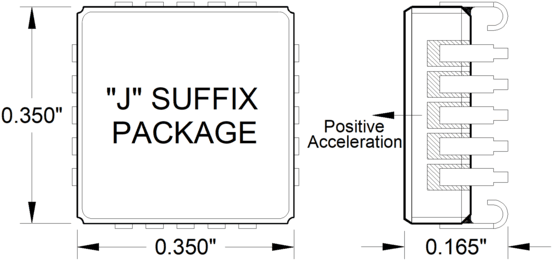
All standard Model 1523 accelerometers use SDI’s 20-pin J-Lead ceramic package. The package is hermetically sealed, and each device is individually serialized. Device mass is approximately 0.68 g.
Package Dimensions
Performance – All Versions
All Models: Unless otherwise specified VDD=VR=5.0 VDC, Tc=25°C, Differential. Span = ±g range = 8000 mV
| PARAMETER | MIN | TYP | MAX | UNITS |
|---|---|---|---|---|
| Bias Calibration Error (mV) | 16 | 40 | ± mV | |
| Bias Calibration Error (Span) | 0.2 | 0.5 | ± % of span | |
| Bias Temperature Coefficient (Tc= -55 to +125°C) | -25 | 0 | +25 | (PPM of span)/°C |
| Scale Factor Calibration Error | 0.5 | 1 | ± % | |
| Scale Factor Temperature Coefficient (Tc= -55 to +125°C) | -50 | 0 | +25 | PPM/°C |
| Non-Linearity (-90 to +90% of Full Scale) | 0.10 | 0.25 | ± % of span | |
| Long Term Bias Stability | 1000 | 2000 | ± PPM of span | |
| Long Term Scale Factor Stability | 500 | 1000 | ± PPM | |
| Cross Axis Sensitivity | 2 | 3 | ± % | |
| Input Axis Misalignment | 5 | 10 | ± mrad | |
| Turn-On Transient (in less than 0.5ms) | 75 | ± PPM of FS | ||
| Output Impedance | 90 | Ohms | ||
| Operating Voltage | 4.75 | 5.0 | 5.25 | volts |
| Operating Current (IDD+IVR) | 5.5 | 6.5 | mA | |
| Mass: 'J' package | 0.68 | grams | ||
| Case Operating Temperature | -55 | +125 | degrees C | |
| Storage Temperature | -55 | +125 | degrees C | |
| Max Reflow Solder Temperature | +239 | degrees C |
Operational Highlights
The Model 1523 sensitive axis is perpendicular to the bottom of the package. Positive acceleration results from positive force applied toward the bottom of the package.
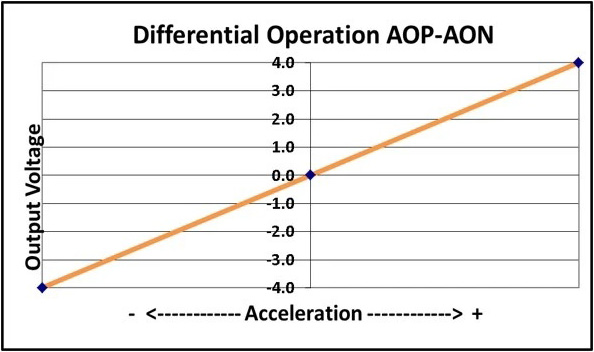
The device produces a differential ±4 V full-scale output proportional to acceleration. Two reference voltages are required: +5.0 V and +2.5 V nominal. Scale factor is ratiometric to the +5.0 V reference relative to GND, and both analog outputs are nominally equal to the +2.5 V input at zero acceleration.
For complete electrical connections, package information, temperature-sensing information, and handling recommendations, refer to the Model 1523 datasheet.
Frequently Asked Questions
How is the Model 1523 different from the Model 1522?
The Model 1523 provides another step in thermal performance within SDI’s industrial surface-mount accelerometer family. Its specified bias temperature coefficient is ±25 ppm of span/°C, and its scale-factor temperature coefficient is -50/+25 ppm/°C. It is intended for applications where tighter control of temperature-related measurement error is required.
Is the Model 1523 an inertial-grade accelerometer?
No. The Model 1523 is an industrial accelerometer. It is designed to narrow the temperature-performance gap between conventional industrial and inertial accelerometers without implying inertial-grade performance across every specification.
That distinction matters because inertial performance involves more than temperature coefficients alone.
What acceleration ranges are currently available?
Standard Model 1523 devices are currently available in ±10 g, ±25 g, and ±50 g ranges.
Does the Model 1523 measure DC acceleration?
Yes. The Model 1523 provides continuous response to 0 Hz DC, allowing measurement of static and very low-frequency acceleration as well as dynamic acceleration within its usable bandwidth.
Does every Model 1523 include calibration data?
Yes. Each device is individually serialized and supplied with a calibration report documenting measured bias, scale factor, linearity, operating current, and frequency response.
Can the internal temperature be monitored?
Yes. The Model 1523 includes a temperature-dependent current output on pin 8 that can be used to monitor internal sensor temperature. See the datasheet for circuit recommendations and electrical characteristics.
Optional Accessories
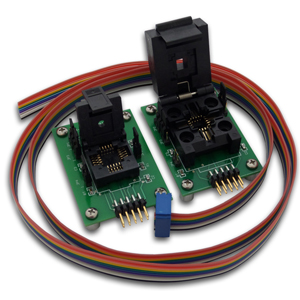
MODELS EB-L & EB-J ANALOG TEST SETS
- INFO
- STATS
- Compatible Sensor Models: 1521 I 1522 I 1523 I 1525 I 1527 I 1531
- Socket Types: JLCC or LCC
-
Includes:
- Test board
- ZIF socket
- 10-pin ribbon cable
- jumpers
- Use with: SDI 3340 G-Logger DAQ
Looking for a Different Performance Level?
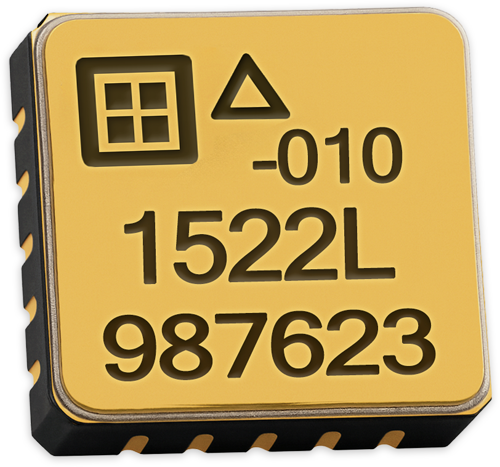
SDI 1522 SURFACE MOUNT ACCELEROMETERS
- INFO
- STATS
- APPLICATIONS
- Power: +5 VDC
-
Output:
- Differential: +/- 4 V
- Single Ended: +0.5V to +4.5V
- Current: 5 mA
- Mass: LCC: 0.62 grams
-
Package:
- J-Lead 20 Pin LCC
- Material: Gold & Ceramic
- Size: 9mm x 9mm x 5mm
- Temperature: -55 to +125°C
- Elevator monitoring
- Platform leveling
- Flight test systems
- Hostile environment R&D
- Calibrating other accelerometers
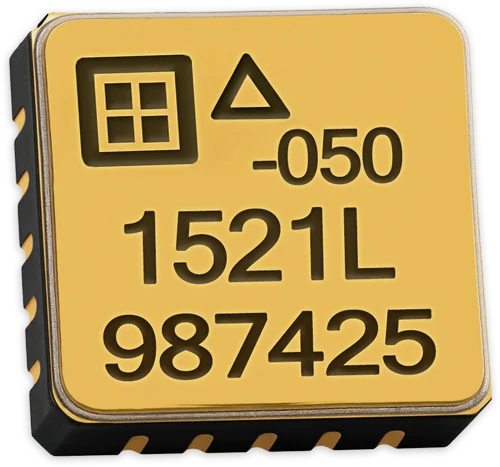
SDI 1521 SURFACE MOUNT ACCELEROMETERS
- INFO
- STATS
- APPLICATIONS
- Power: +5 VDC
-
Output:
- Differential: +/- 4 V
- Single Ended: +0.5V to +4.5V
- Current: 5 mA
- Mass: LCC: 0.62 grams
-
Package:
- J-Lead 20 Pin LCC
- Material: Gold & Ceramic
- Size: 9mm x 9mm x 5mm
- Temperature: -55 to +125°C
- Elevator monitoring
- Platform leveling
- Flight test systems
- Hostile environment R&D
- Calibrating other accelerometers
Sales and Support
Reliable Customer Support from Start to Finish
Get a Quote
Our sales team is available to assist with pricing, lead times, and customized solutions tailored to your specific needs. We work closely with you to ensure you get the best accelerometer solution for your application.
Order Now
With a streamlined ordering process and secure procurement options, placing an order with SDI is simple and efficient. Our commitment to fast processing ensures minimal downtime for your projects.
Tech Support
From initial setup to ongoing performance optimization, our technical support team provides expert guidance to ensure proper integration and reliable sensor operation.
Our Sales Partners
Our experienced U.S. sales representatives provide regional assistance for domestic customers for personalized sales and support. International customers can rely on our global distributor network for local support, timely deliveries, and expert guidance in their regions.
Sign Up For Our Newsletter
Sign up for our newsletter to receive the latest insights on sensor technology, industry trends, and product updates. Be the first to know about advancements in MEMS accelerometers and how they can benefit your applications.
"*" indicates required fields