 Search
 Product Finder
SDI 2220 & 2276 HIGH-PERFORMANCE ACCELEROMETERS
High-performance MEMS accelerometers built for thermal stability, signal clarity, and rugged accuracy
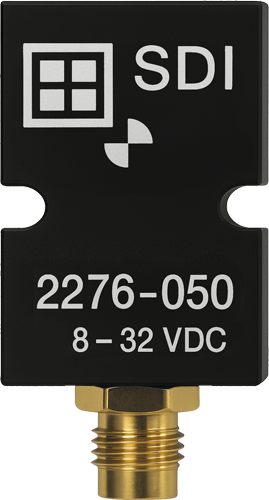
Meet the 2220 & 2276: High-Stability Sensors for Extreme Temperatures
When test and measurement conditions are extreme and accuracy is non-negotiable, the SDI Models 2220 and 2276 provide unmatched performance. Designed for high-reliability environments, these single-axis MEMS DC accelerometers are equipped with enhanced thermal stability, making them ideal for aerospace, defense, transportation, and heavy industrial applications.
Key Performance Features
- Low Noise: 10 μg/√Hz Typical for ±2g Full Scale Versions
- -55 to +125°C Operating Temperature Range
- Flexible +8 to +32 VDC Power
- Excellent Stability Over Temperature
- ±4V Differential Output or 0.5V to 4.5V Single Ended Output
- Responds to frequencies from zero (DC) to 4000+ Hz
- Low Impedance Outputs Support up to 2000 Feet of Cable
- Integrated Cable or Connector, Traditional 1” & Small Footprint Sizes
- Simple Four (4) Wire Connection
- Rugged Anodized Aluminum Case
- Fully Calibrated and Serialized for Traceability
Why Choose SDI’s 2020 and 2276 Test and Measurement Accelerometer
Stability, Clarity, and Endurance for Reliable Performance
The 2220 and 2276 accelerometers are trusted when performance can’t be compromised. With outstanding thermal stability, low noise output, and proven field durability, they’re purpose-built for high-value systems that demand absolute consistency.
Thermally Stable by Design
These models maintain exceptional bias and scale factor accuracy, even under rapid or wide temperature swings. Precision-tuned electronics keep output stable, helping engineers avoid signal drift and recalibration delays.
Clean Signals in Noisy Environments
With a noise floor as low as 10 μg/√Hz, these high-performance MEMS accelerometers offer crisp, dependable data even when exposed to mechanical or electrical interference. Whether measuring vibration or even static acceleration, the output remains clean and reliable.
Rugged Construction That Performs Under Pressure
The epoxy-sealed, fully-potted, aluminum housing is designed to withstand most applications. These accelerometers are field-proven across aerospace and industrial platforms, consistently delivering precision sensing without degradation over time.
Compare Specifications
| g Range | Sensitivity, Differential |
Frequency Response (Typ, 3 dB) |
Frequency Response (Min, 3 dB) |
Frequency Response (Typ, 5%) |
Output Noise, Differential (RMS, Typ) |
Max. Mechanical Shock (0.1 ms) |
|---|---|---|---|---|---|---|
| g | mV/g | Hz | Hz | Hz | μg/(root Hz) | g (peak) |
| ±2 | 2000 | 0 – 525 | 0 – 300 | 0 – 250 | 10 | 2000 |
| ±5 | 800 | 0 – 800 | 0 – 420 | 0 – 400 | 15 | 2000 |
| ±10 | 400 | 0 – 1100 | 0 – 660 | 0 – 700 | 23 | 5000 |
| ±25 | 160 | 0 – 1750 | 0 – 1050 | 0 – 1300 | 38 | 5000 |
| ±50 | 80 | 0 – 2100 | 0 – 1400 | 0 – 1600 | 60 | 5000 |
| ±100 | 40 | 0 – 3000 | 0 – 1700 | 0 – 1700 | 121 | 5000 |
| ±200 | 20 | 0 – 3600 | 0 – 2100 | 0 – 1900 | 243 | 5000 |
| ±400 | 10 | 0 – 4200 | 0 – 2400 | 0 – 2000 | 475 | 5000 |
The 2220 comes in a traditional 1-inch square package with a 10′ integrated cable and is operationally identical to the 2276, the small footprint device designed for tight spaces. The 2220 and 2276 feature a low noise SDI Model 1522 surface mount accelerometer, which is individually tested, programmed, calibrated and verified in a climate chamber to ensure the greatest accuracy in thermally volatile conditions. The 2220 and 2276 include initial calibration reports.
Onboard voltage regulation and an internal voltage reference eliminate the need for precision power supplies. The robust, anodized aluminum case is potted then epoxy sealed and can be mounted easily via two screws, an adhesive, or by attaching a magnet.
Need Help Choosing the Right Accelerometer?
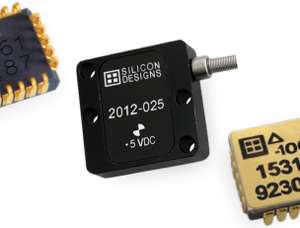
Performance and Packaging
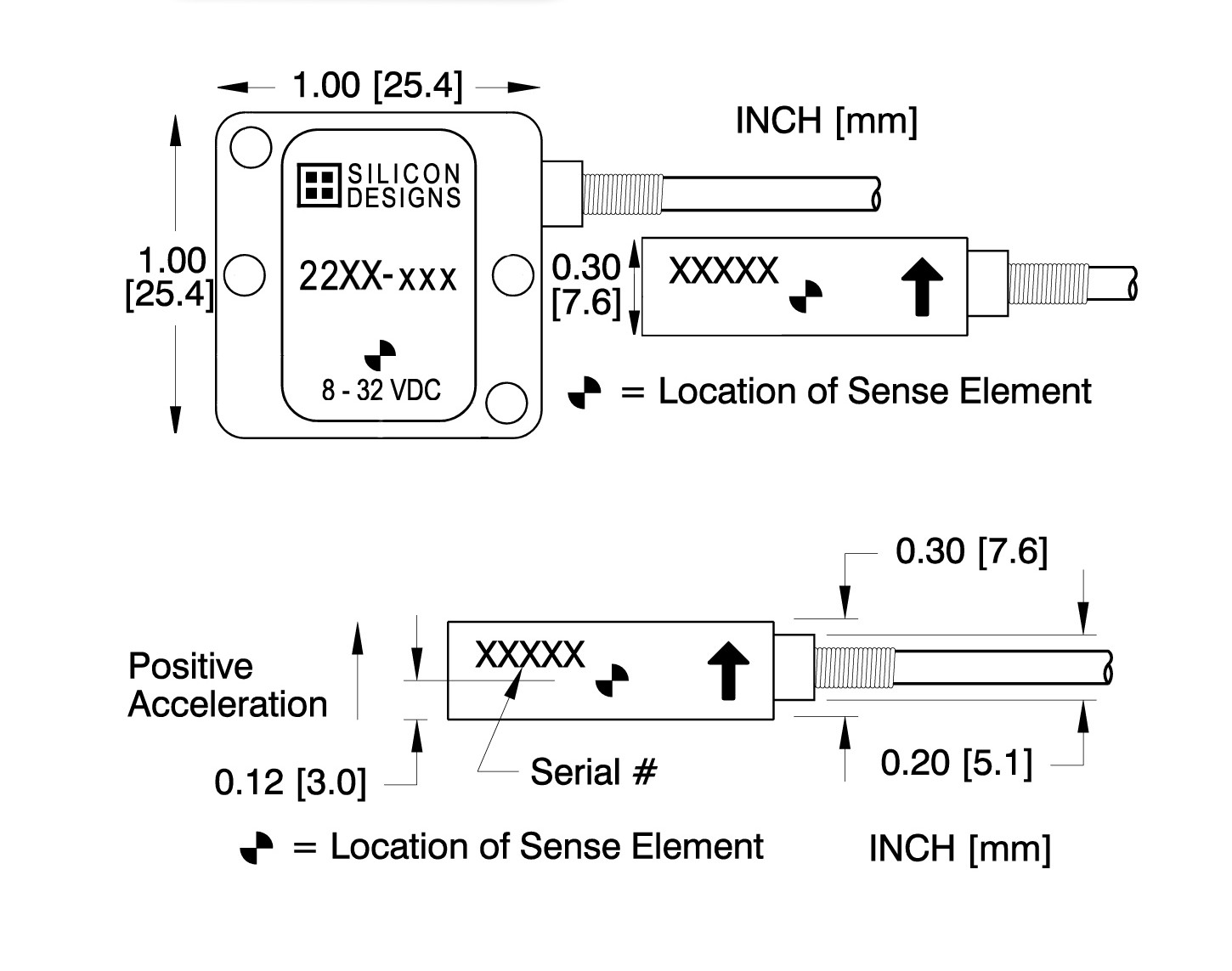
Two form-factors provide maximum adaptability to best suit most applications. The 2220 uses a standard square format with a 10’ cable ending in flying leads. The 2276 fits space-constrained environments with a compact footprint and a connector allows for custom cable lengths without a custom-built price. Both support flexible mounting and rugged handling in high-stakes applications.
Package Dimensions

Package Dimensions 2
PERFORMANCE – ALL VERSIONS
All Models: Unless otherwise specified, Vs=+8 to +32 VDC, TC=25°C, Differential Mode. Span = ±g range = 8000 mV.
| PARAMETER | MIN | TYP | MAX | UNITS |
|---|---|---|---|---|
| Bias Calibration Error (%) | 0.25 | 0.6 | ± % of span | |
| Bias Calibration Error (mV) | 25 | 60 | ± mV | |
| Scale Factor Calibration Error 1 | 0.5 | 1.25 | ± % | |
| Non-Linearity (-90 to +90% of span) 1 | 0.15 | 0.5 | ± % of span | |
| Bias Temperature Shift (Coefficient) | -100 | 0 | +100 | (PPM of span)/°C |
| Scale Factor Temperature Shift (Coefficient) | -150 | 0 | +50 | PPM/°C |
| Cross Axis Sensitivity | 2 | 3 | ± % | |
| Power Supply Rejection Ratio | 50 | >65 | dB | |
| Output Impedance | 1 | Ω | ||
| Output Common Mode Voltage | 2.5 | VDC | ||
| Operating Voltage | 8 | 32 | VDC | |
| Operating Current (AOP & AON open) | 7 | 10.5 | mA DC | |
| Operating Temperature | -55 | +125 | °C | |
| Mass 2220 / 2276 (not including cable) | 10 / 9 | grams | ||
| Cable Mass (10’ integrated cable, 2220) | 4.25 | grams/foot |
Note (1): For 2g thru 50g only; 100g and greater versions are tested and specified from -65 to +65g.
NOTICE: Stresses greater than those listed may cause permanent damage to the device. These are maximum stress ratings only. Functional operation of the device at or above these conditions is not implied.
Operational Highlights
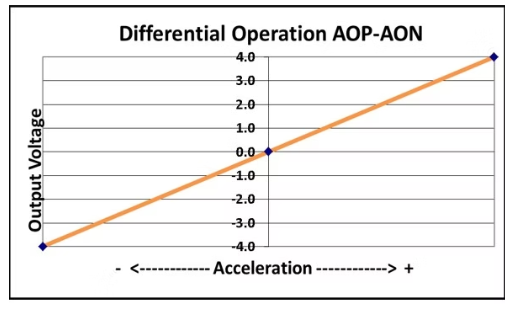
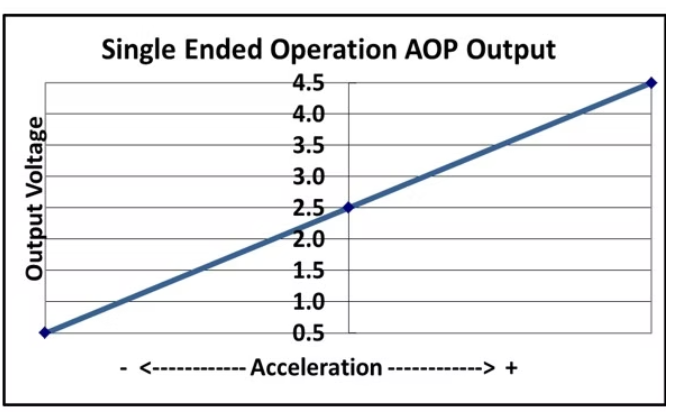
SDI Models 2220 and 2276 MEMS DC Accelerometers provide optimal performance when they are connected to instrumentation in a differential configuration using both the AOP and AON output signals, but they also support single ended operation for complete flexibility.
Accelerometers produce differential analog output voltage pairs (AON & AOP) which vary with acceleration. The signal outputs are fully differential about a common mode voltage of approximately 2.5 volts. At zero acceleration, the output differential voltage is nominally 0 volts DC; at ±full scale acceleration, the output is ±4 volts DC, respectively, as shown in the figure. The output scale factor is independent from the supply voltage of +8 to +32 volts.
When a differential connection is not possible, SDI recommends connecting the accelerometer to instrumentation in single ended mode by connecting AOP and GND to the instrumentation and leaving AON disconnected. Keep in mind that the signal to noise ratio and sensitivity is reduced by half for a single-ended vs. a differential connection.
Frequently Asked Questions
Why does the accelerometer read zero G's when it's in free fall?
All accelerometers are used to measure increasing or decreasing acceleration, and they can detect vibration because it is a change in acceleration between multiple directions. Free fall, by definition, is a static acceleration, which means the object may be moving, but its acceleration is not changing at all. SDI’s MEMS DC accelerometer technology allows it to measure free fall because it doesn’t require any change of acceleration to supply data, and therefore it will report back 0g of acceleration.
How do I choose the right g-range for my application?
The g-range of your accelerometer should match the maximum acceleration your system is expected to experience—but avoid going unnecessarily high. Selecting too high of a g-range can reduce measurement clarity, while too low of a range can cause the sensor to saturate if the acceleration exceeds its limit. Also consider the frequency response. Each Silicon Designs sensor has a MEMS sense element tuned to its specific g-range, which affects its frequency range and noise profile. Be sure to check the product datasheet or visit our How To Choose Your Accelerometer guide for more detailed recommendations. You can also reach out to our team for help identifying the best fit for your application.
My accelerometer appears to be broken. When I place it on the desk with the lid facing up, it reads +1G. How do I fix this?
SDI’s MEMS DC accelerometers are designed to respond to the Earth’s gravity. If you are on Earth, then you are in a +1g gravitational field. Turn the device over and you will see a -1g reading, which you can use to perform your own bias calibration of the device. Visit our Technology page to learn more about how SDI’s accelerometers work. Also see the How to Calibrate Your Accelerometer page for how to use this feature for self-calibration.
Do I need a charge amplifier or signal conditioning to use my Silicon Designs MEMS DC accelerometer module?
All Silicon Designs MEMS DC accelerometers feature integrated amplifiers, so an additional one is not required. Signal conditioning is optional.
Are Silicon Designs plug-&-play MEMS DC accelerometer modules waterproof? What is their IP designation?
While all modules are considered weatherproof, only Models 2240 and 2480 may be used while submerged. We recommend the protection of the connector from exposure. Please Contact Us prior to use, and we’ll walk you through the process. The IP designation of the other modules is IP61.
Optional Accessories
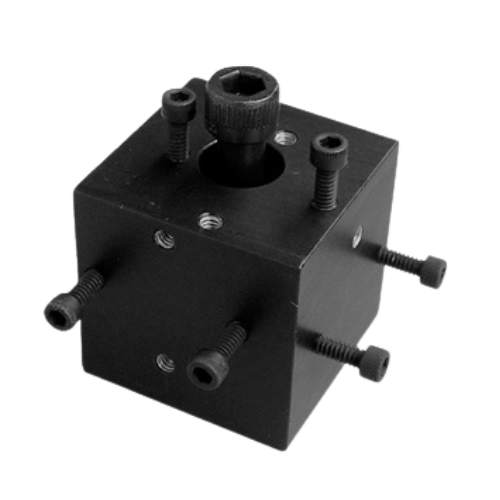
MODEL 2230 3-AXIS MOUNTING BLOCK
- INFO
- Rugged, black anodized, precision-machined 6061-T6 aluminum construction
- Block mass = 79 grams
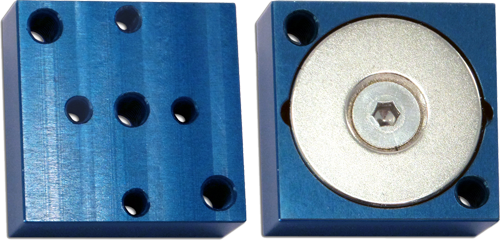
MODEL 2232 MAGNETIC MOUNTING BLOCK
- INFO
- Rugged blue anodized aluminum construction
- Block mass = 23 grams
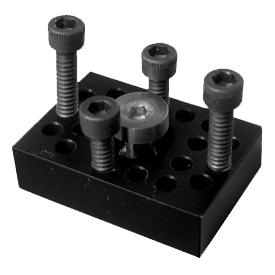
MODEL 2235 1-AXIS STUD MOUNT BLOCK
- INFO
- Rugged black anodized aluminum construction
- Block mass = 6.2 grams
3-Axis Versions Built for Thermal Stability
Need 3-axis sensing with the same thermal reliability and rugged performance?
Models 2470 and 2476 are the multi-axis counterparts to the 2220 and 2276. Built with the same enhanced thermal stability, low-noise 1522 accelerometers, and aluminum housing, these 3-axis accelerometers deliver the same reliable data across all axes.
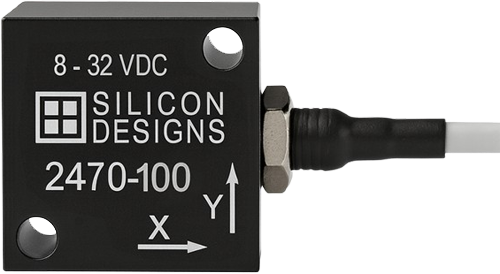
MODEL 2470 3-AXIS MODULE
- INFO
- STATS
- APPLICATIONS
- Power: +8 to 32 VDC
-
Output:
- Differential: +/- 4 V
- Single Ended: +0.5V to +4.5V
- Connection: Integrated Cable
- Mass: 30 grams
- Package: Anodized Aluminum
- Temperature: -55 to +125°C
-
Available:
- 2g
- 5g
- 10g
- 25g
- 50g
- 100g
- 200g
- 400g
- helicopter resonance testing
- automotive NVH
- ride comfort
- suspension design & test
- flight data recording
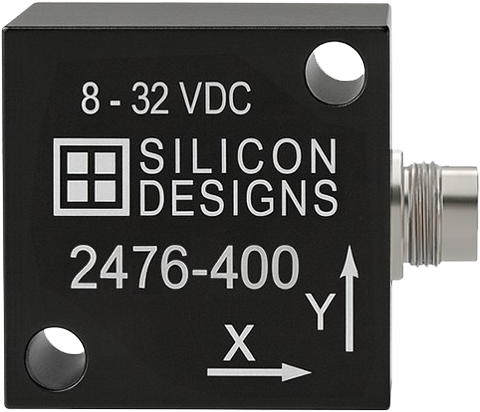
MODEL 2476 3-AXIS MODULE
- INFO
- STATS
- APPLICATIONS
- Power: +8 to 32 VDC
-
Output:
- Differential: +/- 4 V
- Single Ended: +0.5V to +4.5V
- Connection: Connector
- Mass: 30 grams
- Package: Anodized Aluminum
- Temperature: -55 to +125°C
-
Available:
- 2g
- 5g
- 10g
- 25g
- 50g
- 100g
- 200g
- 400g
- MWD equipment vibration
- Aerospace prototype development
- Oil rig platform sensor
- High reliability product R&D
- Low altitude drop testing
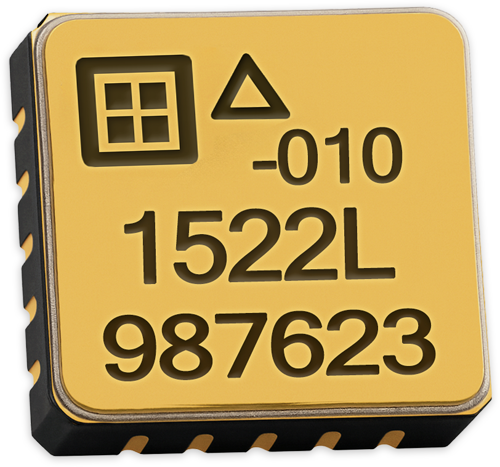
SDI 1522 SURFACE MOUNT ACCELEROMETERS
- INFO
- STATS
- APPLICATIONS
- Power: +5 VDC
-
Output:
- Differential: +/- 4 V
- Single Ended: +0.5V to +4.5V
- Current: 5 mA
- Mass: LCC: 0.62 grams
-
Package:
- J-Lead 20 Pin LCC
- Material: Gold & Ceramic
- Size: 9mm x 9mm x 5mm
- Temperature: -55 to +125°C
- Elevator monitoring
- Platform leveling
- Flight test systems
- Hostile environment R&D
- Calibrating other accelerometers
Sales and Support
Reliable Customer Support from Start to Finish
Get a Quote
Our sales team is available to assist with pricing, lead times, and customized solutions tailored to your specific needs. We work closely with you to ensure you get the best accelerometer solution for your application.
Order Now
With a streamlined ordering process and secure procurement options, placing an order with SDI is simple and efficient. Our commitment to fast processing ensures minimal downtime for your projects.
Tech Support
From initial setup to ongoing performance optimization, our technical support team provides expert guidance to ensure proper integration and reliable sensor operation.
Our Distributors
Our experienced U.S. sales representatives provide direct assistance for domestic customers, ensuring a smooth procurement process with personalized service. International customers can rely on our global distributor network for localized support, timely deliveries, and expert guidance in their regions.
Sign Up For Our Newsletter
Sign up for our newsletter to receive the latest insights on sensor technology, industry trends, and product updates. Be the first to know about advancements in MEMS accelerometers and how they can benefit your applications.
"*" indicates required fields