 Search
 Product Finder
How to Calibrate Your Silicon Designs Accelerometer
Silicon Designs DC accelerometers use MEMS capacitive sensing technology that responds to the Earth’s gravity. When stationary and lying flat, the sensor naturally measures approximately 1G. This makes it easy to verify and perform static calibration using gravity as a reference. The following instructions apply to differential mode operation.
Auto-Calibrating with SDI’s 3330 or 3340 G-Logger
Silicon Designs’ G-Logger® Models 3330 and 3340 include a built-in auto-calibration function. This feature performs all the calculations outlined below for up to three input channels. These G-Logger units also provide the required power for the accelerometer, eliminating the need for an external supply and simplifying the entire process.
Both the 3330 and 3340 models can perform automatic calibrations on SDI’s Industrial Test & Measurement modules, as well as Industrial Surface Mount Accelerometers, when used in conjunction with the SDI EB-L or EB-J Analog Test Kits.
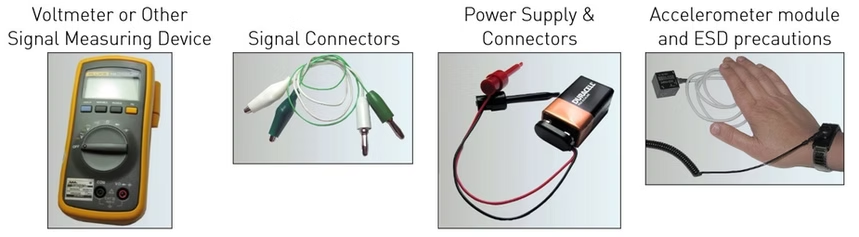
Recommended Equipment
While the example below uses the SDI 2260-025 module, the same calibration process applies to all Silicon Designs Industrial Test & Measurement modules. For triaxial modules, repeat the procedure for each axis. Surface mount accelerometers can be calibrated in a similar manner using the EB-L or EB-J Analog Test Kits.
How to Calibrate (Manual Method)
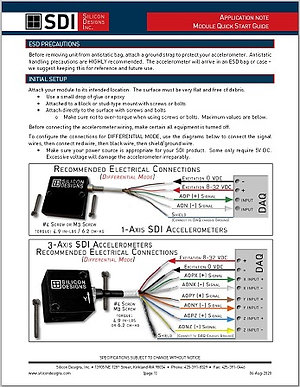
- Connect the wiring
Wire your accelerometer according to the Quick Start Guide. In this example, a 9V battery is used as the power source, which falls within the supported +8 to +32V DC range for the 2260. - Take a +1G reading
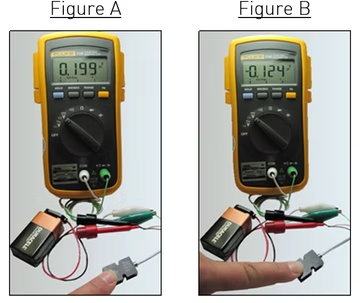
Place the module flat with the lid facing up. Record the output voltage (Figure A). - Take a -1G reading
Flip the module so the lid faces downward. Record the output voltage (Figure B).
Calibration Formulas
Calculate 0G Bias
0G Bias = ½ × (+1G reading + -1G reading)
Example:
This 2260 measures ½ x (.199 + -.124) = .0375
Calculate Scale Factor
Scale Factor = ½ × (+1G reading – -1G reading)
Example:
This 2260 measures ½ x (.199 – -.124) = .1615
Calculate Sensitivity (mV/G)
Sensitivity = (|+1G| + |-1G|) × 1000 / 2
Example:
In this example, the readings were .199 and -.124.
This 2260 measures |.199| + |-.124| x 1000/2 = 161.5mV/G
Estimate Sensitivity Without Live Data
To estimate approximate sensitivity without recorded measurements, divide the output voltage span (converted to mV) by the sensor’s g-range.
Example:
If the output span is ±4V (or 4000 mV), and the g-range is 25G:
4000 ÷ 25 = 160 mV/G
This gives an approximate value of 160 mV per 1G of acceleration.
Sales and Support
Reliable Customer Support from Start to Finish
Get a Quote
Our sales team is available to assist with pricing, lead times, and customized solutions tailored to your specific needs. We work closely with you to ensure you get the best accelerometer solution for your application.
Order Now
With a streamlined ordering process and secure procurement options, placing an order with SDI is simple and efficient. Our commitment to fast processing ensures minimal downtime for your projects.
Tech Support
From initial setup to ongoing performance optimization, our technical support team provides expert guidance to ensure proper integration and reliable sensor operation.
Our Sales Partners
Our experienced U.S. sales representatives provide regional assistance for domestic customers for personalized sales and support. International customers can rely on our global distributor network for local support, timely deliveries, and expert guidance in their regions.
Sign Up For Our Newsletter
Sign up for our newsletter to receive the latest insights on sensor technology, industry trends, and product updates. Be the first to know about advancements in MEMS accelerometers and how they can benefit your applications.
"*" indicates required fields