Search
 Product Finder

Key Takeaways
- EVs change how vehicles are tested, from thermal management to braking, safety, and NVH.
- Each of those systems needs precise data on both sustained motion and dynamic vibration.
- MEMS DC Accelerometers capture both with one sensor, from hard-braking g-forces to subtle cabin vibration.
- The result is cleaner electric vehicle testing data from sensors built to last.
Electrifying a vehicle does more than swap an engine for a battery. It rewrites the rules for thermal management, braking, safety, and NVH, and every one of those systems needs validating with precise, reliable data.
Thermal Management Brings New Testing Demands
An internal combustion engine relies on a single coolant loop. An EV must precisely control the temperature of its battery pack, motor, and power electronics. Testing these systems means tracking low-frequency vibration in coolant lines and thermal connections alongside dynamic inputs from pumps and fans.
Silicon Designs MEMS DC Accelerometers measure from DC up to 4,000+ Hz, depending on range, so one sensor captures both static displacement and dynamic vibration. Models such as the 2220/2276 and 2470/2476 are individually temperature-tested for stable output through hot and cold test cycles from -55°C to +125°C.
Brake Blending Requires Clear Measurement Data
EVs blend regenerative and hydraulic braking, and the handoff between them must stay smooth, especially in emergency stops. Engineers need to see exactly how the system behaves in gradual braking and sudden deceleration.
Mounted on the brake pedal, chassis, and brake components, MEMS DC Accelerometers measure that transition precisely. DC response is essential here: it captures the sustained g-force of hard braking, not just the vibration around it.
Safety Testing Goes Beyond the Crash
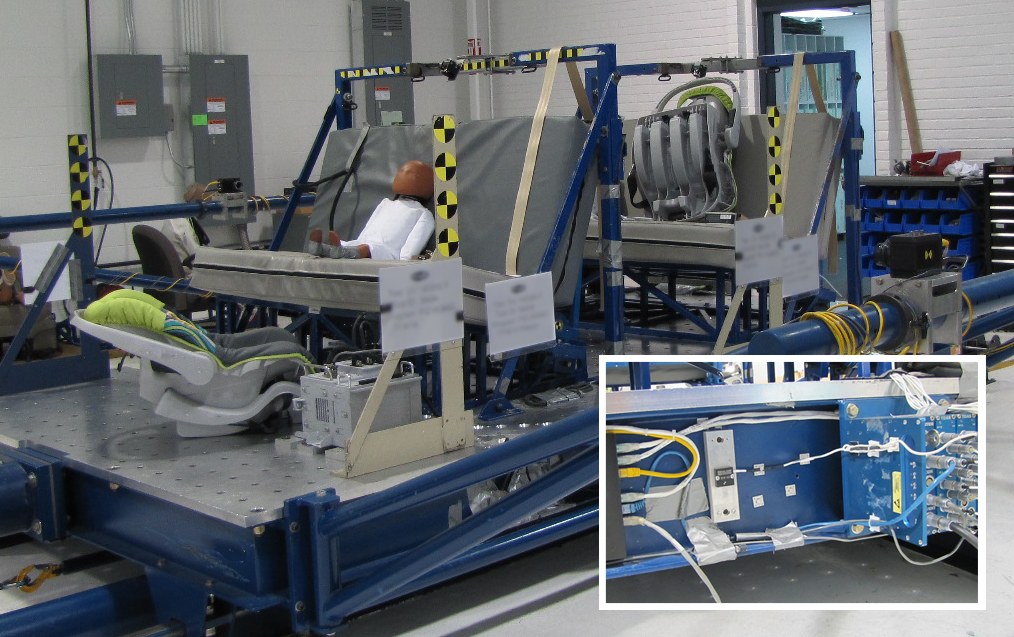
Standard crash evaluations still apply to EVs, but battery systems need closer scrutiny. An EV’s weight distribution and power delivery also change how it behaves in collisions and rollovers.
SDI’s test and measurement modules are rated for mechanical shock up to 5,000 g, depending on range. They survive the impact and keep measuring the low-amplitude vibration and structural deformation that follow.
Rethinking NVH for a Quieter Ride
Without engine noise to mask them, road noise, wind, and motor whine become far more noticeable. Much of what drivers feel starts as low- to mid-frequency, structure-borne vibration from the road, suspension, and mounts.
With DC response and low noise, MEMS DC Accelerometers give engineers a clean view of that vibration in EV NVH testing, helping trace cabin noise to its source and evaluate damping materials.
Don’t Compromise on EV Test Data
The shift to EVs is a major engineering challenge, and your test tools shouldn’t be the limiting factor. Silicon Designs MEMS DC Accelerometers are designed, built, and calibrated in the USA for the precision and durability electric vehicle testing demands.
Find the Right Accelerometer for Your EV Test Program
Planning an EV test program? Every program is different. Thermal, braking, safety, and NVH testing each put different demands on a sensor, from g-range and temperature extremes to mounting space and cable runs. Our team will talk through your application with you and help you choose the right range and configuration. If a standard model doesn’t quite fit, our in-house engineers can work with you on a custom solution.
Frequently Asked Questions About MEMS DC Accelerometers for Electric Vehicle Testing
Why use MEMS DC Accelerometers for electric vehicle testing?
EV systems combine slow, sustained motion with dynamic vibration. MEMS DC Accelerometers respond from DC up to 4,000+ Hz, depending on range, so one sensor can capture static displacement, sustained g-forces, and vibration in the same test.
Can MEMS DC Accelerometers measure regenerative braking?
Yes. Because they respond from DC, MEMS DC Accelerometers capture the sustained deceleration of hard braking as well as the transition between regenerative and hydraulic braking. That makes them well suited to brake testing on the pedal, chassis, and brake components.
How does temperature affect accelerometer data in EV thermal testing?
Temperature swings can cause an accelerometer’s output to drift, which can corrupt data from hot and cold test cycles. SDI’s 2220/2276 and 2470/2476 are individually temperature-tested for stable output from -55°C to +125°C.
Are MEMS DC Accelerometers suited to EV NVH testing?
Yes, for the low- to mid-frequency, structure-borne vibration that makes up much of what drivers feel from the road, suspension, and mounts. Their DC response and low noise give engineers a clean view of that vibration. Higher-frequency content beyond a sensor’s bandwidth may call for a different type of sensor, and our team can help you decide.
Can SDI accelerometers survive EV crash and safety testing?
Yes. SDI’s test and measurement modules are rated for mechanical shock of 2,000 g to 5,000 g (0.1 ms), depending on range, so they can keep measuring after the impact.
Can SDI build a custom accelerometer for my EV test setup?
Yes. SDI designs and manufactures its MEMS DC Accelerometers in-house in the USA. If a standard model doesn’t fit your space, range, or output requirements, our engineers can work with you on a custom solution.