Search
 Product Finder
Silicon Designs is heading to the 40th Annual SmallSat Conference in Salt Lake City, from August 23-26, 2026.
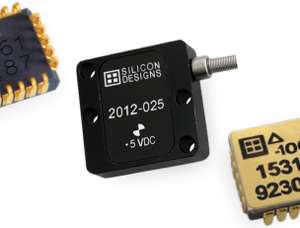
Speak with our engineering team about high-performance MEMS DC accelerometers built to deliver extreme ruggedness during launch, long-term stability across wide thermal shifts, and low-noise performance to capture subtle micro-vibrations.
Visit us in Booth #2106 to see how our MEMS DC accelerometers support satellite programs through every flight phase.
What Makes Capacitive MEMS Accelerometers Reliable for Small Satellite Programs?
Satellite applications are becoming more complex, requiring accelerometers that can survive harsh thermal variations and extreme pressure shifts while sensing low-frequency micro-vibrations. Long-term operational stability is critical to delivering actionable, drift-free data back to the engineering team without early sensor failure.
Our single-axis and multi-axis capacitive MEMS accelerometers address these flight-critical needs, serving as an ideal choice for spaceflight testing, satellite vibration monitoring, dynamic platform stabilization, and inertial guidance, navigation, and control (GNC):
- Balanced Design: Merges high-resolution accuracy with extreme structural shock survival.
- Full-Scale Range: Sensitivity options available from 2g to 400g to fit varied flight profiles.
- Hermetic Reliability: Sealed packaging rated for high-temperature operations up to 175°C.
- Low-Noise Performance: Optimized response from 0 Hz DC to medium frequencies without signal degradation.
- U.S. Manufacturing: 100% U.S. designed, manufactured, and calibrated for full quality assurance and long-term program availability.
By combining rugged, hermetically sealed construction with low-noise performance down to 0 Hz DC, these sensors ensure total data integrity throughout demanding orbital lifecycles.
Find Your Next Accelerometer at Booth 2106 During SmallSat Conference
Small satellite programs need low noise MEMS accelerometers that deliver reliable sensing under high vibration and extreme environments. Talk with our team at SmallSat Conference to review your test setups, evaluate custom packaging requirements, and see how our designs integrate into your spacecraft platforms.
We look forward to seeing you in Salt Lake City.
Unable to attend the conference? Set up a time to meet with our team and discuss your next program requirement.
Frequently Asked Questions About Accelerometers for CubeSat
How do MEMS DC Accelerometers compare to piezoelectric sensors for small satellite sub-systems?
Piezoelectric sensors require dynamic motion and cannot measure constant acceleration or static tilt. MEMS DC accelerometers measure motion down to 0 Hz DC, capturing low-frequency micro-vibrations, steady-state acceleration, and tilt. This makes MEMS technology the preferred choice for flight testing, GNC, and platform stabilization in small satellite platforms.
Can MEMS DC Accelerometers withstand launch shock and orbital thermal extremes?
Yes. High-performance MEMS DC accelerometers feature hermetically sealed packaging rated for extreme operating temperatures up to 175°C and high structural shock survival.
How is long-term calibration retention maintained over extended space missions?
Thermal variations and mechanical stress can induce sensor bias drift over time. Our MEMS DC accelerometers built with variable capacitance silicon structures and hermetic packaging deliver low noise, low-drift stability, and long-term calibration retention without requiring frequent recalibration.
How do SDI accelerometers support inertial navigation and guidance (GNC) in GPS-denied space environments?
Our low noise MEMS accelerometers provide accurate, continuous linear acceleration data down to 0 Hz DC, enabling onboard guidance systems to calculate precise velocity updates, monitor thrust vectoring during orbit maneuvers, and maintain attitude control without accumulative sensor-induced drift.